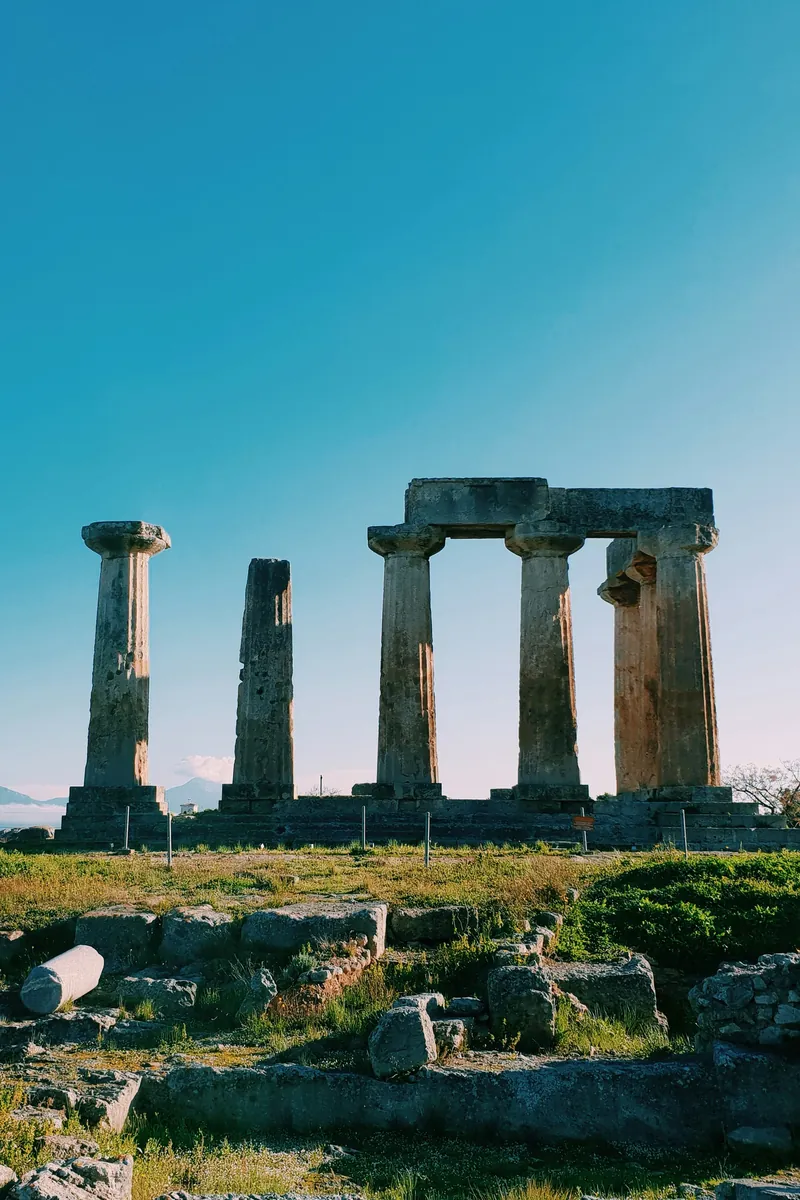
The seven surviving Doric columns of the Temple of Apollo at Ancient Corinth, standing above the ruins with the Acrocorinth citadel behind

Walk the forum of Corinth where Greece met Rome and the Apostle Paul once stood

Ancient Corinth skip-the-line timed entry — the wealthy city-state of the Peloponnese, its 6th-century-BC Temple of Apollo, Roman forum and marble Lechaion Road, with the site museum included. We reserve your dated hourly slot so you walk past the ticket-office queue straight to the gate.

See ticket options
  • 6th C. BC Temple of Apollo built
  • 7 Doric columns still standing
  • 44 BC Refounded by Julius Caesar
  • 80 km West of Athens

Choose your ticket

  • Book in your languageYour currency, final price.
  • Pro tips includedBest slots, the monuments most visitors rush past.
  • Ready before you flyMobile ticket, ready in your inbox.
  • 24/7 human supportReal people, instant answers — any hour, any time zone.
4.8 from 128 verified travellers
Sophie R.
Manchester, England
“We showed our phones at the gate and walked straight in while a coach group queued at the ticket office in the sun. Standing under the columns of the Temple of Apollo, then finding the Bema where Paul once stood, was extraordinary. The short audio history beforehand made every ruin make sense.”
May 2026
David M.
Sydney, Australia
“Booking and picking our hourly slot was so easy. We took an early slot to beat the heat and had the forum and the Lechaion Road almost to ourselves. The on-site museum was a lovely surprise — included and well worth the extra half hour.”
April 2026
Anna L.
Hamburg, Germany
“The ground is open and gets hot fast, so good shoes and a hat matter. Reserving our slot ahead meant no queuing in 33-degree heat. The Peirene Fountain and the columns of Apollo were my favourites — go early and you'll love it.”
June 2026

5-minute audio guide

Your 5-minute Ancient Corinth pre-visit briefing

A short, calm narrative — the great Greek and Roman city of Corinth, the Temple of Apollo, the forum where the Apostle Paul once stood, what to look for as you walk the ruins, and how to read the site and its museum. Listen on the road from Athens or as you reach the gate.

Included with your booking — your full guide arrives with your ticket.Get your guide
  • Mid-6th century BC — the Temple of Apollo rises, one of the earliest Doric temples in mainland Greece
  • 146 BC — Rome sacks the Greek city; in 44 BC Julius Caesar refounds it as a Roman colony
  • The Roman forum, the marble-paved Lechaion Road and the monumental Peirene Fountain at the city's heart
  • The Bema — the platform where, per the Acts of the Apostles, the Apostle Paul stood before the proconsul Gallio
  • Seven monolithic limestone columns of the Temple of Apollo still standing above the ruins
  • Best timing: take the first or last hourly slot to beat the heat and the coach groups

Recorded for Ancient Corinth Tickets concierge. Free to download.

About Archaeological Site of Ancient Corinth

Ancient Corinth was one of the great cities of the classical world — a wealthy, powerful city-state of the Peloponnese that commanded the narrow Isthmus of Corinth, the land bridge between mainland Greece and the Peloponnese, and controlled trade between two seas. Rising to prominence in the Archaic period, it was famed for its craftsmen, its pottery and its riches. Its most enduring monument, the Temple of Apollo, was raised in the mid-6th century BC and stands as one of the earliest Doric temples in mainland Greece; seven of its massive monolithic limestone columns still rise above the ruins today, about 80 kilometres west of Athens.

The city's history turns on two Roman moments. In 146 BC the Roman general Lucius Mummius sacked Greek Corinth and left it in ruins; a century later, in 44 BC, Julius Caesar refounded it as a Roman colony, and it grew rich again as the capital of the Roman province of Achaea. Most of what you walk through today is that Roman city: the great forum, the marble-paved Lechaion Road leading down toward the port, the monumental Peirene Fountain fed by its natural spring, and the Bema, the raised speaker's platform where, according to the Acts of the Apostles, the Apostle Paul was brought before the proconsul Gallio during his stay in Corinth. The Archaeological Museum of Ancient Corinth stands on the site itself and is included in your ticket, gathering the finds from more than a century of excavation.

The site sits in the village of Ancient Corinth, about seven kilometres southwest of the modern town of Corinth and roughly 80 kilometres from Athens, an easy day-trip that often takes in the Corinth Canal on the way. Above the ruins looms Acrocorinth, the dramatic fortified citadel on its own high rock — a separate hilltop site, not part of this ticket. The ground is open and largely unshaded, so early-morning or late-afternoon hourly slots are far kinder than the middle of the day. Because entry is timed by the hour, we handle the ticketing in your own language and reserve the slot you want, so you can give your energy to the ruins instead of the queue.
Practical information

Opening hours
Open daily, year-round. Summer (roughly April–October) approx. 08:00–20:00; winter (November–March) shorter daytime hours, often around 08:30–17:00. Entry is timed by the hour and last entry is about 30 minutes before closing. Hours are set by the operator and change seasonally and on public holidays — confirm on the day of your visit.
Address
Archaeological Site of Ancient Corinth, Ancient Corinth 200 07, Corinthia, Peloponnese, Greece.
Getting there
Ancient Corinth is about 80 km west of Athens, in the village of Ancient Corinth roughly 7 km southwest of the modern town of Corinth. From Athens the suburban railway (Proastiakos) runs to Corinth station, from where a local bus or a short taxi reaches the ancient site; intercity KTEL buses also serve Corinth. By car it is about an hour from Athens, and the drive passes the Corinth Canal, a popular stop. The site museum is on the grounds and included in the ticket; the Acrocorinth citadel above is a separate site.
Accessibility
An open archaeological site on gently sloping ground, with gravel paths, ancient paving, steps and uneven surfaces across the ruins. Sun exposure is high and shade is limited. Sturdy shoes, a hat and water are strongly recommended; visitors with limited mobility can see much of the forum area and the museum but should allow extra time and note that some paths are rough or stepped.
Bag policy
Day bags are fine. There is no large-luggage storage on site, so leave suitcases at your accommodation or in Corinth.
Photography
Personal photography is welcome across the site and generally in the museum. Tripods, professional equipment and drones may require permission; some display areas post their own signs.

About our service

Ancient Corinth Tickets is an independent concierge service that helps international visitors reserve and receive their timed-entry tickets in English. We are not the archaeological site and we are not an official vendor — we purchase genuine entry tickets on your behalf from the Hellenic Ministry of Culture's official ticketing service, and our service fee is included in the price you see. If you prefer to buy directly, the operator's own ticket site is tickets.hh.gr.

Frequently asked

Is this a skip-the-line ticket?

Your hourly slot is reserved before you arrive, so you walk straight to the site gate instead of queuing at the Ancient Corinth ticket office. On busy days that queue can take a while as tour groups and cruise coaches arrive from Athens and the port, so coming with your ticket already in hand saves the wait in the sun.

How does the timed entry work?

You choose the date and an hourly time slot, and your ticket is valid for a single entry during that hour on that day. Just arrive within your slot window and show your mobile ticket at the gate; last entry is about 30 minutes before closing.

What's included in the ticket?

Full admission to the Ancient Corinth archaeological site — the Temple of Apollo, the Roman forum, the Lechaion Road, the Peirene Fountain and the Bema — and the Archaeological Museum of Ancient Corinth, which stands on the site and is covered by the same ticket. It does not include the Acrocorinth citadel above, which is a separate site.

Is the site museum included?

Yes. The Archaeological Museum of Ancient Corinth is on the grounds of the archaeological site and is included in your entry ticket. It holds the sculpture, mosaics, pottery and everyday finds recovered from more than a century of excavation, and makes a natural indoor complement to the open-air ruins.

Is Acrocorinth included in this ticket?

No. Acrocorinth, the great fortified citadel on the rock above the city, is a separate site reached by a road up the hill, and it is not covered by this ticket. Our ticket is entry to the archaeological site of Ancient Corinth on the lower ground, together with its on-site museum.

How and when do I get my ticket?

We send your ticket to your email as a mobile ticket once your booking is confirmed — there's nothing to print, just show it on your phone at the gate. You'll also receive a short 5-minute audio history to listen to before you go.

How do I get to Ancient Corinth from Athens?

Ancient Corinth is about 80 km west of Athens. The suburban railway (Proastiakos) runs to Corinth station, from where a local bus or a short taxi reaches the ancient site about 7 km away; intercity KTEL buses also serve Corinth. By car it is roughly an hour, and the drive passes the Corinth Canal, a popular stop on the way.

What is the connection to the Apostle Paul?

The Apostle Paul spent around eighteen months in Corinth in the first century AD, founding one of the early Christian communities and later writing his letters to the Corinthians. In the forum stands the Bema, the raised speaker's platform where, according to the Acts of the Apostles, Paul was brought before the Roman proconsul Gallio — one of the reasons the site draws many visitors interested in early Christian history.

When is the best time to visit?

Book the first hourly slot after opening, or one of the last slots before closing, and travel outside the July–August peak if you can. The ground is largely unshaded, so the middle of a summer day is both the hottest and the busiest stretch, when day-trip coaches from Athens and cruise groups overlap. An early or late slot gives cooler air and a calmer walk among the ruins.

How long should I allow for the visit?

Most visitors spend about 1.5 to 2 hours on site, taking in the Temple of Apollo, the forum and its monuments and the museum. Add more time if you want to linger over the museum's collection or climb to the Acrocorinth citadel above, which is a separate site and a longer half-day.

Do I need to bring my passport or any ID?

No. The standard entry ticket is not personalised and needs no passport or name — just show your mobile ticket at the gate. (Reduced and free-entry categories set by the operator may require ID at the gate; our ticket is standard full admission.)

Is the site wheelchair accessible?

Partly. Ancient Corinth is an open archaeological site with gravel paths, ancient paving, steps and uneven ground, though the central forum area and the museum are reachable with care. Visitors with limited mobility can see a good deal of the site but should allow extra time and expect rough or stepped surfaces in places.

Is Ancient Corinth open all year?

Yes — the site is open daily, year-round. Only the daily hours change with the season: longer in summer (roughly 08:00–20:00) and shorter in winter, with timed entry by the hour and last entry about 30 minutes before closing. Hours can change on public holidays, so confirm on the day.

Can I change my slot after booking?

Changes are allowed up to 2 hours before your visit, with a maximum of 2 changes per ticket, provided your preferred new slot is still open. If your plans shift, contact our team and we'll help where the operator's rules allow. See our terms for the full policy.

Can I get a refund?

All bookings are final once confirmed; we only issue a refund in the rare event the operator cannot honour a validly issued ticket. Timed-entry tickets are non-refundable, but you can change your slot up to 2 hours before your visit within the operator's rules. See our terms for details.

Are you the official Ancient Corinth ticket office?

No. We're an independent concierge service for international visitors. We buy genuine tickets on your behalf from the Hellenic Ministry of Culture's official ticketing service and handle the booking in your own language, and our service fee is included in the price shown. You can always buy directly from the operator if you prefer.

What currency am I charged in?

The price you see is the price you pay — we show it in your local currency where we can and charge exactly that amount, with no surprise fees at checkout. Payment is by card on a secure page.

Why book with you instead of buying at the gate?

Two reasons: you skip the on-the-day queue by reserving your hourly slot in advance, and you get it all handled with 24/7 human support and a pre-visit audio history. Our service fee is included in the price — there are no extras at checkout.